What Do You Think People Could Do to Help This Animals Population Grow Again African Penguin
Skip to Content
Artificial colonies provide hope for penguins in South Africa
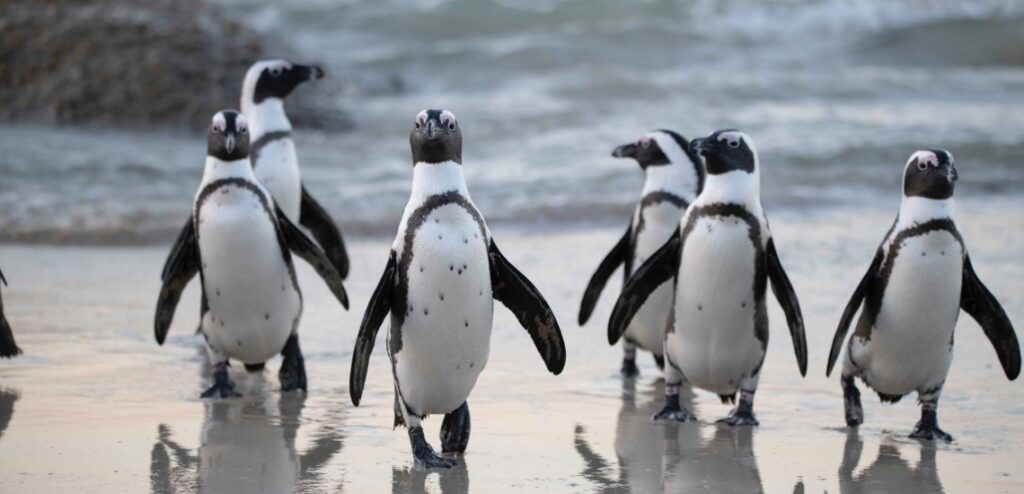
With numbers plummeting and food hard to observe, African Penguins face a dour hereafter – merely BirdLife South Africa has a programme to ensure they thrive once again.
By Elena Serra Sánchez and Jeanette Smith
Off the Southern African coast are some of the about productive waters in the world. The waters are habitation to a broad array of biodiversity including dolphins, whales, sharks in add-on to seabirds including albatrosses and petrels. Many of these birds are increasingly under threat from human being activities including angling, oil spills and development as well equally climate change.
Such is the case of the African PenguinSpheniscus demersus, besides known as the Greatcoat penguin, simply found on the south-western tip of Africa in South Africa and Namibia. Different other penguins, this species bucks the cold climate trend, surviving in temperatures of over 30° C.
In the last few decades, the population of African Penguins has dramatically decreased. In one case numbering about one.5–iii meg individuals, the African Penguin population dropped to 300,000 past 1956, and the numbers kept on falling. "Last twelvemonth, in that location were fewer than 13 000 pairs in South Africa", highlights Dr Alistair McInnes, Seabird Conservation Program Manager at BirdLife Southward Africa (BirdLife Partner). With only 1% of the size of their population in the 1900s, the species is classified as Endangered on the IUCN Red List. According to a 2018 study African Penguins would exist extinct from the west coast of South Africa by 2035 if current patterns are maintained.

"Last year, there were fewer than 13 000 pairs of African Penguins in S Africa".
Dr Alistair McInnes, Seabird Conservation Programme Director at BirdLife South Africa
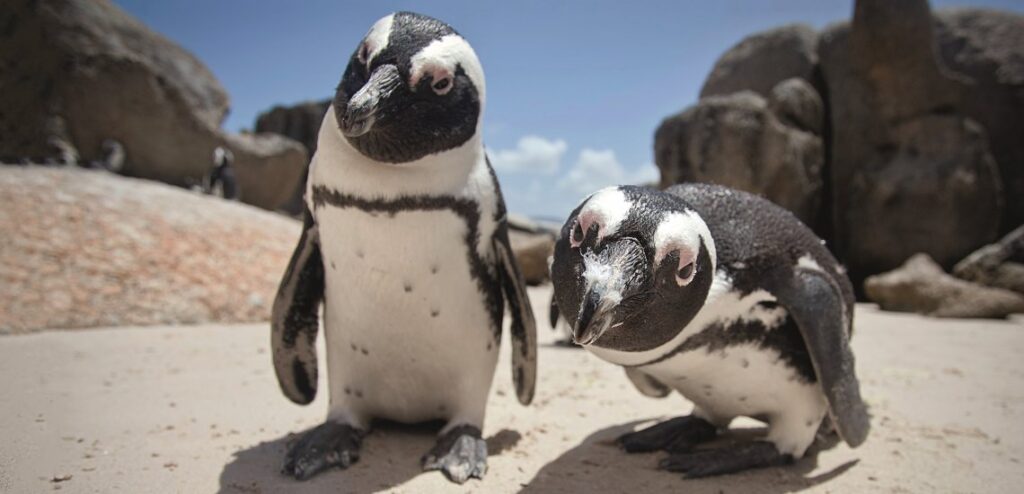
In improver to egg collection and guano harvesting for fertilizer, reduced availability of this species food, mainly anchovy and sardines, has led to this massive population decline. Decades of overfishing have decimated fish stocks, thus threatening the survival of African Penguins. Growing penguin chicks need a diet very high in lipids – something that sardine and anchovy provide. Equally if conditions for the penguins weren't bad enough, enquiry suggests that when seabird chicks are fed on lower quality "junk food", they are slower to develop and can experience decreased cognitive ability, making it harder for the young birds to find food once they have fledged.
African Penguins generally breed on islands where they are safe from predators. Due to shifts in the distribution of their prey, there is at present a mismatch between penguin breeding islands and the fish stocks, as convenance penguins can't hunt farther than 40km, at about, from the breeding nest if they are to feed their young regularly. "There is a 600 km stretch of coastline between Dyer Island and Port Elizabeth where in that location are no islands, and therefore no breeding penguins, which effectively splits the South African population in ii", explains Dr Alistair McInnes. To counter this situation, BirdLife South Africa is investigating options of creating new penguin colonies on a stretch of the southward coast of South Africa that has no offshore islands but high fish abundance.
The aim is to create resilience in the penguin population by increasing the number of colonies and to bridge the gap between the west and east populations and enable penguins to breed in a region that has healthy prey supplies. "Working with CapeNature and other penguin experts, we identified the De Hoop Nature Reserve on the southern coast, 300 km east of Cape Town, as a suitable identify to start", explains Dr Alistair McInne.
Previous penguin breeding attempts were unsuccessful due to predation, leading to abandonment of the colonies. To forbid this from recurring, BirdLife South Africa has installed a predator-proof fence -designed in conjunction with a wildlife contend expert- along the perimeter of the site. The site has too been equipped with a remote monitoring system with cameras that send alerts to projection staff when predator motion is detected.
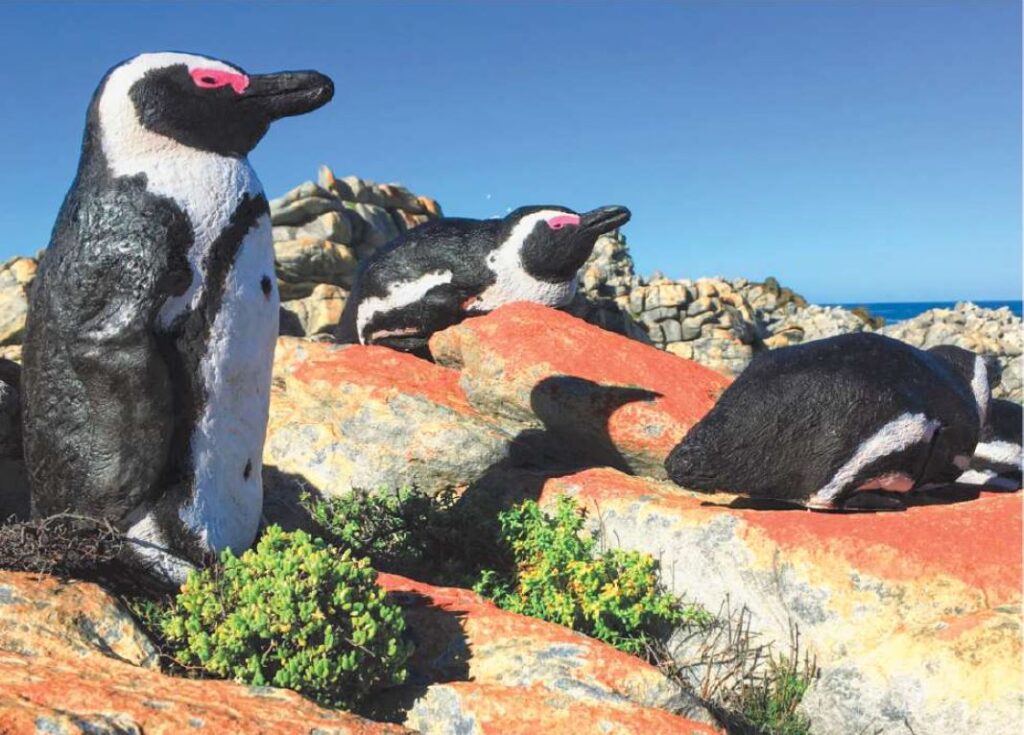
Because penguins breed in colonies, they are less likely to adopt a new site with no penguins already breeding there. Consequently, BirdLife South Africa is using decoys and playing penguin calls to concenter birds from sea. BirdLife South Africa is besides planning to release young penguins from the Hoop, to encourage them to return and brood. In one case penguins start breeding in a colony they return there annually – a trait which helps them find the same mate again. It is hope that through these strategies, penguins volition colonize Hoop, thus helping increment the populations numbers.
Collaborations are critical in advancing penguin conservation. To this end, BirdLife South Africa'due south Coastal Seabird Team is working with the government and the fishing manufacture, advocating for an ecosystem arroyo to fisheries (EAF) management, that incorporates ecosystem and socio-economic concerns into the fisheries direction framework rather than the conventional approach that is centered around a single species.
An example of this approach is the African Penguin Isle Closure Experiment BirdLife South Africa has been working closely with other NGO'due south, seabird scientists and the regime, to assess the impact of bag-seine angling closures around four of the largest African Penguin convenance colonies since 2009. Results of this study will be used by the regime fisheries management to decide to limit resource competition in sensitive penguin habitat.
Farther, the Coastal Seabird Squad is working on unlike approaches integrating ecosystem concerns into the way catch limits are fix for sardine and anchovy – key casualty species for three of iv most threatened coastal seabird species in South Africa
To understand the foraging distribution of the African Penguins, the team has identified areas where convenance penguins go to forage. Additionally, information technology has tracked non-breeding African Penguins since 2012 from major colonies such as Dassen Island, Stony Point and Bird Island. Currently, BirdLife South Africa is in the process of analysing this, which will be critical to Marina Protected Area expansion assessments.
The African Penguin is facing an uncertain future, but by moving penguins closer to their food and trying to ensure there are more than fish in the sea, information technology is hoped their populations will thrive once again.
Latest news from Africa
Stay upwards to date
Our monthly newsletter curates the almost fascinating articles across BLI's piece of work to salve birds everywhere.
Source: https://www.birdlife.org/news/2021/04/25/artificial-colonies-provide-hope-for-penguins-in-south-africa/
0 Response to "What Do You Think People Could Do to Help This Animals Population Grow Again African Penguin"
Post a Comment